
For the first time in seven years the prime minister finds himself at his most vulnerable, observes Virendra Kapoor.

Eighteen months after the economy was battered by the Covid-induced lockdown, employment has not recovered to its pre-pandemic levels, points out Mahesh Vyas.
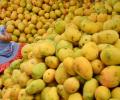
The plucking of dussehri, which will hit the shelves next week at 50% premium, started late this season, because of poor crop and adverse weather conditions, including hailstorms, in the orchards of Malihabad.
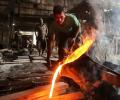
Prime Minister Narendra Modi on Friday said production linked incentive (PLI) scheme, which is aimed at boosting domestic manufacturing and exports, is expected to increase the country's production by $520 billion in the next five years. Addressing a webinar on PLI scheme, organised by Department of Industry and International Trade (DPIIT) and NITI Aayog, through video conference, Modi said the government is continuously carrying out reforms to boost domestic manufacturing. In this year's Budget, about Rs 2 lakh crore was earmarked for the PLI scheme for the next five years and "there is an expectation that the scheme would result in increasing the production by about $520 billion in the next five years", he said. He added that there is also an expectation that the current workforce in the sectors, which will avail the benefits of the PLI scheme, will be doubled and job creation will also increase.
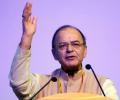
Is the Budget sufficiently prudent? It probably is but at the cost of substantial under-provisioning for the many grand sounding schemes announced in it, says Nitin Desai.
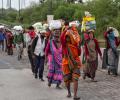
The beneficiaries of the second set of announcements are expected to be micro, small, and medium enterprises, farmers, women, poor, migrant workers, and other marginalised sections of the society, reports Arup Roychoudhury.
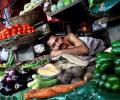
'The availability of vegetables has gone down due to fewer arrivals in wholesale mandis. Their supply was disrupted because of low yields and high spoilage,' says Shyam Bhimraoji Karlekar, chairman, APMC Wardha, one of the largest sellers of vegetables in Maharashtra.
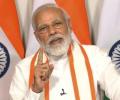
Speaking at industry association CII's annual session, PM Modi said the government has taken tough steps to fight the coronavirus pandemic and has also taken care of the economy. "On the one hand we have to safe the lives of our people and on the other hand we have to stabilise the economy and speed up the economy," he said. "Yes, we will definitely get our growth back," he asserted.

Open market price cools down as chief minister orders cold storages to empty stock by December 15.
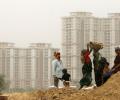
The new land Acquisition Bill has many implications.
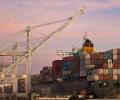
The country's exports dipped 8.74 per cent to $23.52 billion in November on account of contraction in shipments of key sectors like petroleum, engineering, chemicals and gems and jewellery, official data showed on Tuesday. Trade deficit during the month narrowed to $9.87 billion as imports too declined by 13.32 per cent to $33.39 billion.
Because of the reluctance to intervene structurally in the political economy of onion trade, the BJP is paying the price till today and might continue to do so in the forthcoming election to the Delhi assembly.
It is in no way a government of the economic Right. The Right is limited to religion and nationalism. The rest is as Left as the Congress or any other party, observes Shekhar Gupta.

'Chief Minister Devendra Fadnavis called us for a meeting in March 2016 and we submitted the same charter of demands that we are submitting now.' 'He gave us wishy-washy assurances.' 'We thought he was the new chief minister and we believed him, but later we found out that nothing is moving on the ground.' 'This time we want a written assurance and a concrete timetable for implementation.' 'We will not leave Mumbai, come what may.'

Check out some of the stocks that will react on the basis of their numbers in the near term.

Agri-enterprises are finding it hard to expand due to lack of commercial guidance.
Prime Minister Narendra Modi's landslide election in 2014 raised hopes he would draw a line under India's socialist past, cut welfare and reduce the government's role in business.
Citing rising prices, slowdown in growth and depreciation of rupee among the problems facing the economy, the opposition members said in the Lok Sabha that they feared the repeat of the 1991 crisis when the country had to mortgage gold as it failed to meet short-term debt obligations.

The benchmark M-30 variety of sugar has declined by over 3 per cent in November to trade now at Rs 3,694 per quintal
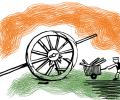
Pragmatism and flexibility is a virtue. An untethered and short-term approach to policymaking is a flaw, argues Mihir S Sharma.

'There is a great scope for enhancing the use of organic fertilisers'.

The bitter political rivals -- the ruling LDF and the UDF -- close ranks in the state assembly to oppose the ban.
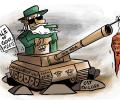
The promise of a less suspicious government is surprising. What about the disconnect between the new business stance and earlier push to dictate the narrative in politics and public life, wonders T N Ninan.

Recent data from market analytics firm Nielsen shows that the rural market in the country's 630,000-odd villages is pulling down the overall FMCG business.

'I asked a group of uniformed high school kids: Who was the one Kashmiri they admired?' 'I shouldn't have been surprised by the answer,' says Sunil Sethi.

Finance Minister Nirmala Sitharaman on Monday presented the Budget for 2021-22 in the Lok Sabha that is expected to provide relief to the pandemic-hit common man as well as focus more on driving economic recovery through higher spending on healthcare, infrastructure and defence amid rising tensions with neighbours, As India emerges from the COVID-19 crisis, the ninth Budget under the Modi government, including an interim one, is widely expected to focus on boosting spending on job creation and rural development, generous allocations for development schemes, putting more money in the hands of the average taxpayer and easing rules to attract foreign investments.
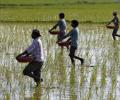
Telangana's Rythu Bandhu policy is an embryonic UBI, or rather embryonic QUBI (a quasi-universal basic income, pronounced Kyoo-Bee). And it could potentially also be the future of agricultural policy in India, says Arvind Subramanian.
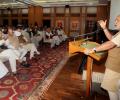
Prior to the strike, bookies were expecting 200-230 seats for the BJP in the coming polls, for which they were offering 1:1 odds (Re 1 win for every rupee bet). But now they are anticipating 245-251 seats for the party and over 300 for the NDA, more than enough to form the next government, reports Rajesh Bayani.
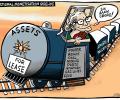
But use of that word -- privatisation -- is not encouraged. This seems to be a classic case of reforms through subtle signals, observes A K Bhattacharya.

With GDP growth improving to a nine-quarter high of 5.7 per cent and the stock market brimming with optimism, now is the time for Modi to keep his promises.

The land transfer or subleasing would allow the Patanjali Group to set up the food processing facility and entitle it to other incentives under the central policy guidelines.

Quinoa is said to play a role in the treatment of as many as 20-odd ailments, including liver problems, angina, notes Surinder Sud.
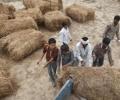
The agrarian crisis must be met with similarly speedy responses.
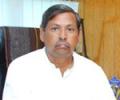
After getting a nod from apex court, GCMMF on Friday held the election in the presence of poll observer.

He added that the rival parties had tried to project the Bharatiya Janata Party as communal and therefore "untouchable" but the people realised that the party stood for their welfare.

Kerala's Tirur betel leaf, Tawlhlohpuan and Mizo Puanchei from Mizoram, and Palani Panchamirtham, a temple 'prasadam' from Tamil Nadu have been awarded Geographical Indication tag.

ugar mills in UP owe thousands of crores to cane farmers.

Prices of milk and derivatives such as cheese, butter, curd and skimmed milk powder were subdued for two years, on a supply surplus.

The sugar industry clamouring for control and intervention should set the alarm bells ringing in the corridors of power.

Overall, small savings have amassed Rs 1.17 trillion from April-September - 26 per cent more than the previous year. But in those six months, the economy lost 24 per cent in the first three months, and is slated to lose 10 per cent in the second quarter.
 © 2026 Rediff.com - Advertise with us - Disclaimer - Privacy Policy - Sitemap - Feedback - About us - Terms of use - Grievances